 FREE SHIPPING OVER $199

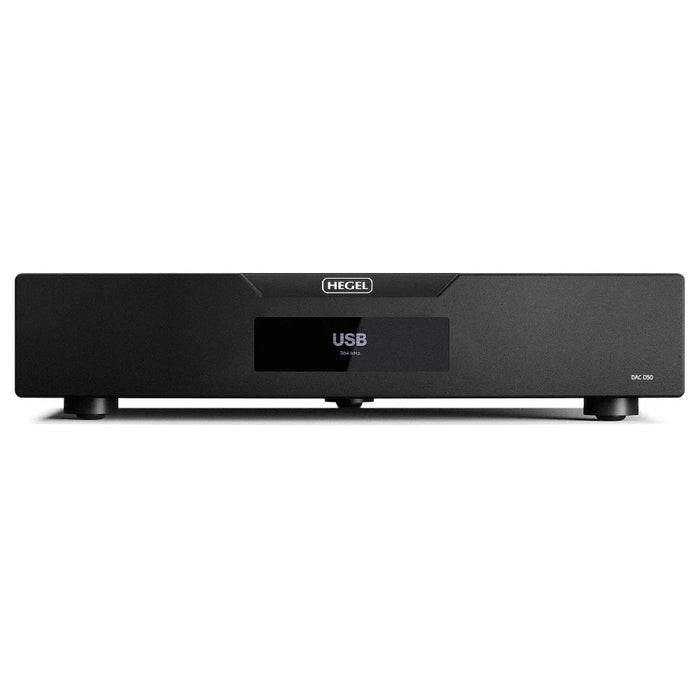
Hegel DAC D50


Hegel DAC D50
$5,900.00
Product Details
Hegel D50 DAC at Vinyl Sound Toronto, Canada
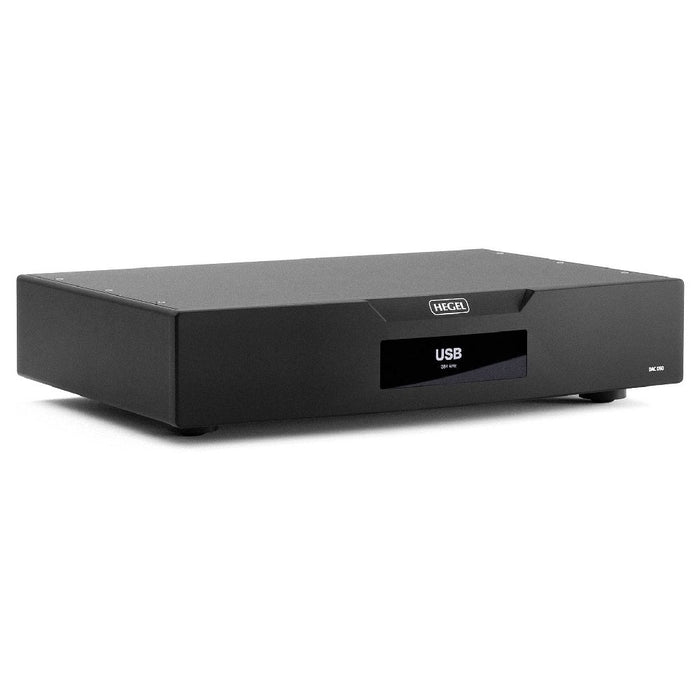
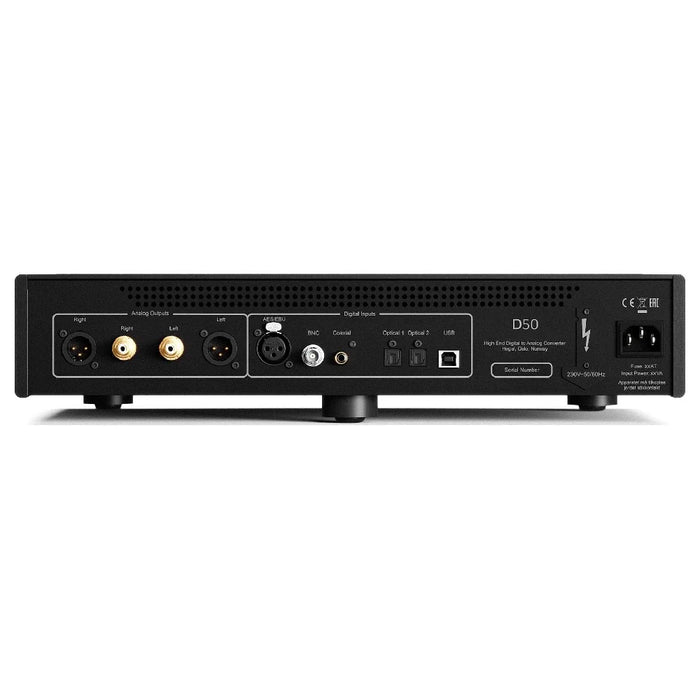
The Hegel D50 is the reference digital-to-analogue converter from Hegel Music Systems (Oslo, Norway), available at Vinyl Sound in Toronto, Canada. With a noise floor of typically -150 dB and THD below 0.0002%, the D50 represents over two decades of Hegel DAC engineering distilled into a single, uncompromising component. It accepts every major digital input format including USB 32/384, AES/EBU, BNC and RCA coaxial, and optical, and delivers its output via fully balanced XLR and unbalanced RCA analogue connections at 2.5V RMS. For audiophiles seeking the most accurate and natural translation from digital to analogue in any system, the D50 is the definitive answer.
Frequently Asked Questions
Q: What is the Hegel D50?
A: The Hegel D50 is a reference standalone DAC from Hegel Music Systems featuring a triple master clock reclocking system, dual independent toroidal transformers, THD below 0.0002%, and a noise floor of typically -150 dB. It accepts USB up to 32/384 with DSD256, AES/EBU, BNC and RCA coaxial, and two optical inputs, with balanced XLR and unbalanced RCA analogue outputs at 2.5V RMS.
Q: How does the Hegel D50 compare to the DAC built into Hegel integrated amplifiers?
A: The D50 is a dedicated, full-size reference DAC with significantly more elaborate power supply engineering, a triple master clock architecture, an elevated DAC chip board, transformer-balanced AES/EBU input, and a noise floor of -150 dB that exceeds what is practical to implement within an integrated amplifier. For listeners who want the absolute best digital performance from their Hegel system, adding the D50 as a dedicated front end represents a meaningful and audible upgrade over the built-in DACs in any Hegel integrated amplifier.
Q: Why does the Hegel D50 use three separate master clocks?
A: Digital audio has two fundamental sample rate families: 44.1 kHz and its multiples, and 48 kHz and its multiples. Using a single master clock to handle both requires compromise. The D50 uses a dedicated clock for each USB sample rate family and a third for S/PDIF inputs, ensuring every incoming signal is reclocked against a perfectly matched precision reference and eliminating jitter completely before the signal reaches the DAC chip.
Q: Does the Hegel D50 support DSD and MQA?
A: Yes. The D50 supports DSD256 via DoP on the USB input, DSD64 via DoP on the AES/EBU and coaxial inputs, and MQA 8x decoding across all compatible digital inputs.
Q: What is the AES/EBU input on the Hegel D50 and why is it better than standard S/PDIF?
A: The AES/EBU input on the D50 uses a transformer-balanced RS422 receiver, a unique implementation that handles both weak and strong incoming signals without jitter or time delays. Standard S/PDIF connections are single-ended and more vulnerable to ground noise and cable-induced jitter. For sources that offer an AES/EBU output such as professional CD transports and high-end music servers, connecting via AES/EBU to the D50 delivers the cleanest possible digital handoff.
Q: Can the Hegel D50 improve the performance of other components in my system?
A: Yes, in two ways. First, its advanced mains filtering reduces noise on the power supply circuit, which can benefit other components connected to the same grounded outlet. Second, using the D50 as a dedicated front end for any Hegel or third-party integrated amplifier or preamplifier removes digital noise from the amplifier chassis entirely, lowering the overall system noise floor.
Q: Where can I buy the Hegel D50 in Toronto or Canada?
A: The Hegel D50 is available at Vinyl Sound in Toronto, Canada, an authorised Hegel dealer. Contact us to arrange an in-store audition or to discuss integrating the D50 into your existing system.
Key Tech Specs
Hegel's reference DAC pairs a triple master clock reclocking system and dual toroidal transformers with THD below 0.0002% and a noise floor of typically -150 dB.
Image Gallery
In Depth
Two Decades of DAC Expertise in One Component
The D50 is built around the latest-generation DAC chip, but Hegel's philosophy is that the chip itself is only the beginning. Every aspect of the circuit design, board layout, power management, clocking architecture, and signal routing has been engineered to extract the full potential of that chip rather than leaving it constrained by a generic implementation. The DAC chip is mounted on a separate elevated board above the main electronics to minimise noise and interference while providing the shortest possible signal paths. Circuit board traces use rounded corners throughout to minimise impedance drops and reduce electromagnetic radiation. The result is a DAC that measures extraordinarily well and sounds even better than its measurements suggest.
Triple Master Clock Architecture and Jitter Elimination
Jitter, the timing irregularity in digital audio, is one of the primary causes of digital harshness and listener fatigue. The D50 addresses this with three dedicated master clocks: one for S/PDIF signals, and separate master clocks for 44.1 kHz and 48 kHz USB sample rate families. All incoming digital signals are fully reclocked by these precision oscillators before reaching the DAC chip, ensuring perfectly timed conversion regardless of the quality of the source. The AES/EBU input features a unique transformer-balanced RS422 receiver capable of handling both weak and strong signals without jitter or time delays. S/PDIF inputs are received on a custom-designed card that unpacks the I2S data before reclocking, eliminating the noise and timing errors inherent in the S/PDIF format at the source.
Dual Toroidal Transformer Power Supply
The D50 uses two independent low-noise toroidal transformers, each shielded by thick steel and positioned as far as possible from sensitive electronics. One transformer powers the digital processing and standby circuitry; the other is dedicated exclusively to the sensitive analogue and precision digital components. Advanced mains filters on the power input further eliminate noise from the supply, and when connected to a properly grounded outlet, this filtering can also improve the performance of other components sharing the same mains circuit.
Technical Specifications
Similar items


